Services
Custom software development
Internal platforms, integrations and automation built around how your company actually works — not around what a generic tool allows.
You already know when it's time
The signs are always the same. Three people maintaining the same spreadsheet and nobody sure which copy is current. A process that only works because someone remembers the exception. Software you pay for monthly that solves eighty percent of the problem while your team handles the rest by hand. Data in four systems that don't talk to each other, reconciled manually every month.
None of that is a technology problem yet. It becomes one when the manual work starts costing more than the system that would replace it — and by then it's usually been true for a while.
What we build
Internal platforms
Operations systems, admin panels, inventory and order management, dashboards for people who need to make decisions without asking someone to export a report first.
Integrations
Connecting what you already use — ERPs, CRMs, electronic invoicing, payment gateways, logistics providers, marketplaces — so data moves on its own instead of through a person copying it between tabs.
Automation
Processes that run on schedule or on trigger: document generation, notifications, reconciliation, reporting. The work nobody should be doing by hand in the first place.
Legacy modernization
Systems that still work but nobody wants to touch. We take them over, document them, stabilize them and modernize them in stages — without turning your operation off while we do it.
What we build it with
Node.js, PHP and Laravel on the backend, PostgreSQL and Prisma for data, Next.js, React, TypeScript and Tailwind CSS on the interface, deployed on AWS with Docker, Nginx, Cloudflare and continuous integration.
Two of those deserve a note. We work in PHP and Laravel as first-class tools, not as a legacy concession — a large share of the business software running in Latin America is built on them, and refusing to touch it is how agencies leave clients stranded. And we choose deliberately conventional technology: the goal is that another competent team could take over your system without a translation layer.
How we work
- 01
Discovery
We map what the system has to do, who uses it and what it connects to. You leave this stage with a written technical plan, a scope and a fixed number, whether or not you continue with us.
- 02
Architecture
Data model, integrations, permissions and — for SaaS — the tenancy and billing model. The decisions that are expensive to reverse get made here, on paper, before anyone writes code.
- 03
Build
Two-week sprints with a working environment you can open and click through at the end of each one. Direct access to the engineer writing the code, not to an account manager relaying messages.
- 04
Launch and support
Deployment, documentation and handover of everything: repositories, servers, accounts. Then a support agreement if you want one, or a clean goodbye if you don't. Your project shouldn't depend on us being available.
Work of this kind

Madre Ceiba Properties
Bilingual property platform for a coastal agency
A real estate agency on the Oaxacan coast was invisible to Google: its listings rendered in the browser, so search engines saw empty pages where the inventory should be, and half its market searches in English. We rebuilt it server-rendered and bilingual, every property indexable in both languages.
See the case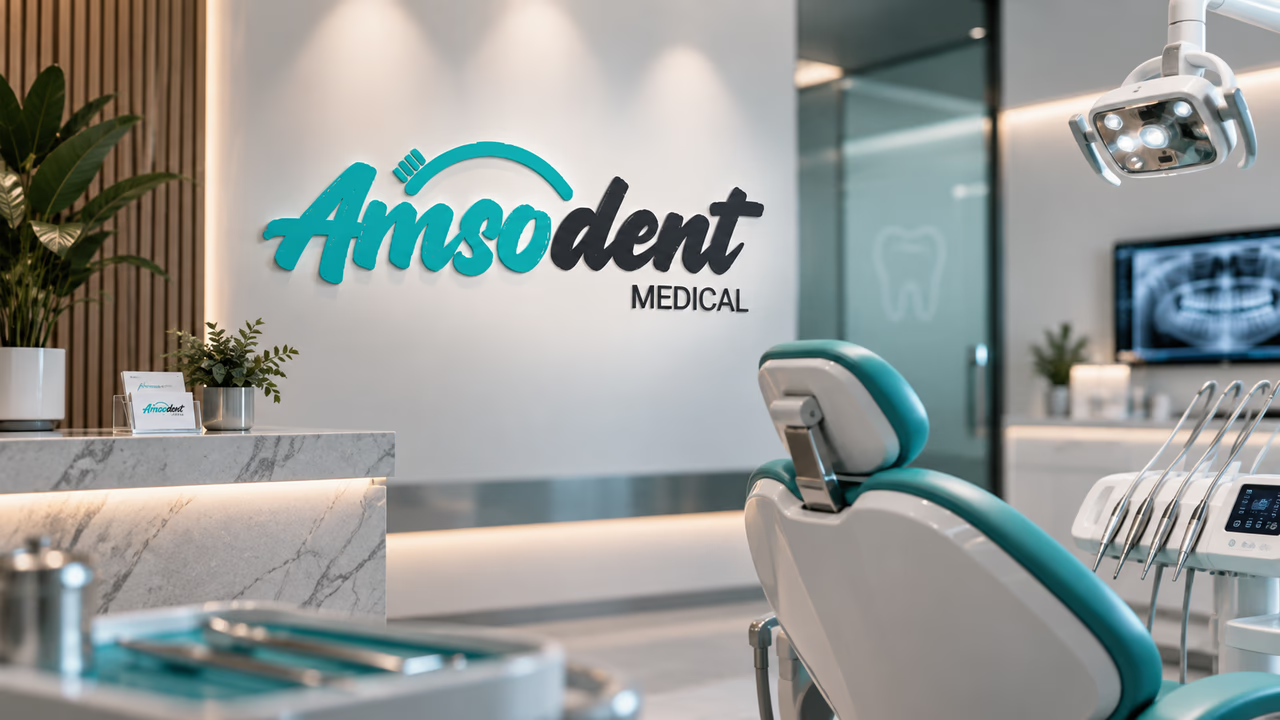
Amsodent Medical
Custom ecommerce platform for medical distribution
A dental and medical supply distributor had outgrown WooCommerce, which could not express how the business actually sells. We built the platform around its real rules: approved professional pricing, lots and expiry dates, partial shipments and returns that land back in the ledger correctly.
See the caseFrequently asked questions
Is custom software more expensive than buying a subscription?
Upfront, almost always. Over three or four years, often not — a subscription is a cost that grows with your headcount and never becomes an asset. The honest answer depends on how badly the existing tool fits, and we'll tell you when the subscription is the better deal.
How long does it take?
A focused internal platform typically runs 8 to 12 weeks. Integrations and automations are usually shorter. You get a real estimate after discovery, not in the first call.
Can you work with our existing system instead of replacing it?
Usually yes, and usually that's the better path. Replacing everything at once is the most expensive and riskiest way to modernize.
What happens if we want to bring development in-house later?
Everything is documented and transferable. That's the point of using conventional technology.

Tell us what's breaking
Describe the process that's costing you time. You'll get a first read on feasibility, approach and rough range from an engineer — not an automated reply.
RelatedSaaS platformsMobile appsCode audits and project rescue